从“体验性水墨意象”到时间与存在的东方表达
Yao Jianwei Wins the Athena Art Award for Art and Philosophy
2026-08-16·原文来源: news.malayhome.org/info/z-l6k8b7k82l.html
佛罗伦萨——2026年意大利雅典娜艺术奖(Athena Art Award)获奖名单近日公布,中国艺术家姚建伟荣获“艺术与哲学奖”(Award for Art and Philosophy)。这一认可不仅是对其艺术实践的肯定,也将他持续演进的“体验性水墨意象”(Experiential Ink Imagery)概念带入更广阔的国际艺术语境。尤其值得注意的是,姚建伟并未将水墨艺术的当代转型局限于形式创新。相反,他的实践日益转向对时间、生命、记忆与存在等更深层问题的追问,使水墨成为个人经验与哲学反思汇聚的场域。
FLORENCE — The winners of the 2026 Athena Art Award in Italy were recently announced, with Chinese artist Yao Jianwei receiving the Award for Art and Philosophy. The recognition not only acknowledges his artistic practice, but also brings his evolving concept of “Experiential Ink Imagery” into a broader international art context. Particularly noteworthy is that Yao has not confined the contemporary transformation of ink art to formal innovation. Instead, his practice has increasingly turned toward deeper questions of time, life, memory, and being, transforming ink into a field in which personal experience and philosophical reflection converge.
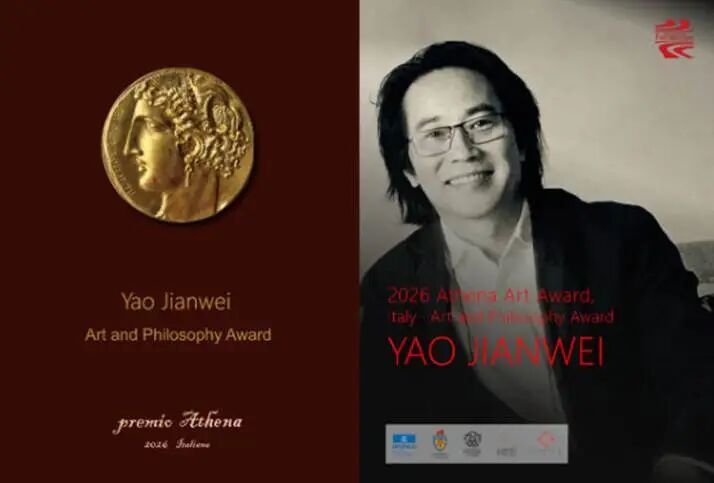
图为 姚建伟
在姚建伟近期的作品中,叙事性的景观与可辨识的物象逐渐退隐。取而代之的,是水与墨在宣纸上的铺展、层叠、断裂与沉积,并由此成为作品自身的核心。墨不再只是描绘对象的媒介,而成为一个正在发生过程中的事件。绘画也因此从对预设图像的生产,转向对图像生成过程本身的体验。
In Yao Jianwei’s recent work, narrative landscape and recognizable objects have gradually receded. In their place, the spreading, layering, rupturing, and sedimentation of water and ink on xuan paper have become central to the work itself. Ink is no longer merely a medium for depicting an object; it becomes an event in the process of occurring. Painting, accordingly, shifts from the production of a predetermined image toward an experience of the image as it comes into being.
这正是“体验性水墨意象”中“体验”二字的意义所在:它既不是题材,也不是强加于作品之上的概念标签,而是一种创作与存在的方法——身体的运动、材料的回应、时间的流逝、记忆的苏醒、艺术判断,以及不可预知的偶然,共同参与图像的生成。姚建伟的问题因此不再只是“如何运用水墨”,而是:在图像被命名之前,它如何从人的经验、时间与材料之中生成?
This is precisely the significance of “experience” within Experiential Ink Imagery. It is neither a subject matter nor a conceptual label imposed upon the work, but a method of creation and existence: bodily movement, material response, the passage of time, the awakening of memory, artistic judgment, and unpredictable chance all participate in the formation of the image. Yao’s question is therefore no longer simply how ink can be used, but rather: before an image is named, how does it emerge from human experience, time, and material?
其代表性的《时间》系列,使这一追问尤为鲜明。
The representative Time Series brings this inquiry into particularly sharp focus.
对姚建伟而言,时间既意味着流逝,也是一种超越个体生命的连续性。它包含变化与成长,同时也是我们理解自身存在的基本维度之一。人无法存在于时间之外:记忆、经验、选择,乃至我们对世界的理解,都持续在时间之中形成。因此,《时间》系列并非只是对“岁月流逝”的诗意再现,而是试图将时间转化为一种可以被观看、被体验的图像结构。时间不再只是作品所表现的主题,而成为作品自身得以生成的机制。
For Yao, time signifies both transience and a form of continuity that extends beyond individual life. It encompasses change and growth while also constituting one of the fundamental dimensions through which we understand our own existence. Human beings cannot exist outside time: memory, experience, choice, and even our understanding of the world are continuously formed within it. The Time Series, therefore, is not simply a poetic representation of “the passage of years.” Rather, it attempts to transform time into a pictorial structure that can be seen and experienced. Time is no longer merely the subject represented by the work; it becomes a mechanism through which the work itself is generated.
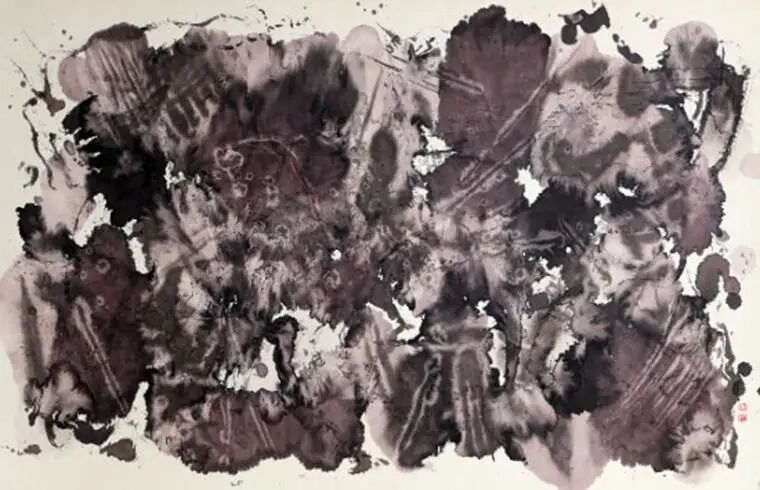
姚建伟,《时间》,纸本水墨,73 × 110 cm,2025
因此,《时间》系列中那些模糊、重叠、甚至时而几乎难以命名的色域,获得了一种超越形式本身的意义。色彩的暧昧性成为衡量生命绵延的一种感知尺度。层层色墨彼此覆盖、渗透、退隐并重新显现,对应着成长、记忆与心理经验的过程。生命并非由孤立的瞬间构成;它在时间持续的累积、叠加与修订中获得深度与广度。也正是在这种不断变化的过程中,个体体验自我、与世界相遇,并逐渐形成对存在的理解。
The blurred, overlapping, and at times almost unnameable fields of color in the Time Series consequently acquire a significance that extends beyond form itself. The ambiguity of color becomes a kind of perceptual measure of the duration of life. Layers cover, penetrate, recede, and re-emerge, corresponding to processes of growth, memory, and psychological experience. Life is not composed of isolated moments; it acquires depth and breadth through the continuous accumulation, superimposition, and revision of time. It is within this process of constant change that the individual experiences the self, encounters the world, and gradually develops an understanding of being.
横向展开、具有书法性的笔触,又为画面引入另一种时间节奏。东方水墨绘画的生命力、动作性与时间意识,与现代抽象艺术中的运动、偶然性和视觉张力相遇。姚建伟并非简单并置东方与西方的形式,而是在这两种视觉传统之间,寻找一种属于当代经验的感知方式。
The horizontally unfolding, calligraphic brushwork introduces another temporal rhythm into the paintings. The vitality, gestural qualities, and temporal consciousness of Eastern ink painting encounter the movement, contingency, and visual tension associated with modern abstraction. Yao does not simply juxtapose Eastern and Western forms; rather, he searches between these two visual traditions for a mode of perception that belongs to contemporary experience.
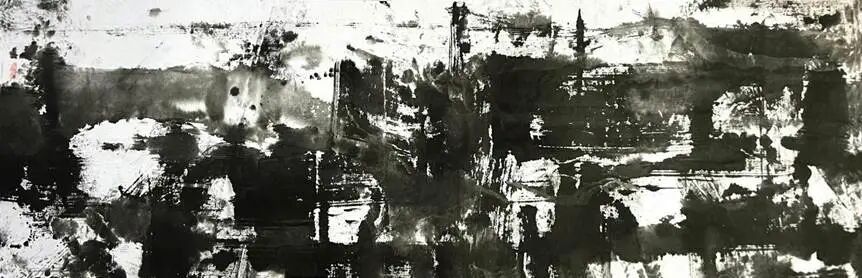
姚建伟,《时间》,纸本水墨,58 × 177 cm,2023
人的记忆从不会以完整的时间序列被保存。更多时候,它会被某种熟悉的感受突然唤醒:过去重新进入当下,曾经被遮蔽的情绪与经验再次浮现于表面。《时间》系列中那些反复被覆盖又重新显露的痕迹,恰恰具有这种心理特质。有些事物看似消失,却从未真正离去;某些经验或许被后来一层层的时间覆盖,却仍在更深处继续塑造今天的我们。
Human memory is never preserved as a complete chronological sequence. More often, it is suddenly awakened by a familiar sensation: the past re-enters the present, and emotions and experiences once concealed rise again to the surface. The traces that are repeatedly covered and revealed in the Time Series possess precisely this psychological quality. Some things have disappeared without ever truly leaving; certain experiences may have been covered by subsequent layers of time, yet they continue, at a deeper level, to shape who we are today.
因此,这些作品所处理的时间超越了编年式的时间,进入心理时间与切身经验中的时间。层叠的转化既唤起世界无休止的变迁,也提出个体如何在变化之中维持自身连续感的问题。面对不可逆的时间洪流,个体或许显得微不足道,但人的选择、行动和记忆不断赋予有限的生命以意义。即便时间仿佛在无尽循环中展开,生命也绝非只是重复,因为每一次选择都会改变经验的结构。
The time addressed in these works therefore moves beyond chronological time into psychological and lived time. Their layered transformations evoke both the ceaseless changes of the world and the question of how an individual maintains a sense of continuity within that change. Against the irreversible current of time, the individual may appear insignificant, yet human choices, actions, and memories continually endow finite life with meaning. Even if time appears to unfold in endless cycles, life is never merely repetitive, because every choice alters the structure of experience.
也正是在这里,姚建伟的“体验性水墨意象”开始超出有关水墨现代化的传统讨论。
It is precisely here that Yao Jianwei’s Experiential Ink Imagery begins to move beyond the conventional discussion of the modernization of ink painting.
艺术家并非在一个每个决定都能够被无限撤销的数字界面中工作;他面对的是一个随时间不可逆展开的材料过程——其中每一次行动都要求判断,每一个决定都会留下后果。
The artist does not work within a digital interface where every decision can be endlessly undone. He confronts instead a material process unfolding irreversibly through time—one in which every action requires judgment and every decision leaves a consequence.
因此,“体验性水墨意象”并不是把传统媒介当作抵抗技术的手段。相反,在一个日益技术化的文明之中,它试图重新确认人的身体、时间、记忆与切身经验的意义。当机器越来越能够生成图像时,艺术或许更需要追问一个更为根本的问题:
Experiential Ink Imagery, therefore, does not use a traditional medium as a form of resistance to technology. Rather, within an increasingly technological civilization, it seeks to reaffirm the significance of the human body, time, memory, and lived experience. As machines become increasingly capable of producing images, art may need to ask an even more fundamental question:
图像之外,人究竟真正经历了什么?
Beyond the image, what has the human being actually experienced?
姚建伟此次获得2026年意大利雅典娜艺术奖——“艺术与哲学奖”,为重新审视其艺术实践提供了一个新的国际参照坐标。然而,比奖项本身更重要的是,他能否继续推动“体验性水墨意象”的发展,使其不止是一种具有辨识度的当代水墨语言,而进一步确立为一种更为完整的艺术方法论,持续关涉时间、生命、记忆与存在。
Yao Jianwei’s receipt of the 2026 Athena Art Award in Italy — Award for Art and Philosophy provides a new international point of reference from which to consider his practice. Yet more significant than the award itself is whether he can continue to develop Experiential Ink Imagery beyond a distinctive language of contemporary ink painting and establish it as a more comprehensive artistic methodology concerned with time, life, memory, and being.
从这个意义上说,姚建伟的《时间》系列并非描绘已经逝去的时间,而是让时间参与绘画行为,让记忆再次发生,并通过水、墨与色彩不断展开的相互作用,使切身经验获得可被感知的形式。
In this sense, Yao Jianwei’s Time Series does not depict time that has already passed. It allows time to participate in the act of painting, enables memory to occur again, and gives lived experience a perceptible form through the unfolding interaction of water, ink, and color.
因此,水墨不再只是再现世界的媒介,而成为人理解自身、感知世界,并追问时间之中存在本质的一种方式。
Ink, therefore, is no longer merely a medium through which the world is represented. It becomes a way for human beings to understand themselves, perceive the world, and question the nature of existence within time.
作者:Adam Blake(亚当·布莱克)
译注:原文核心概念 “Experiential Ink Imagery” 本文译作“体验性水墨意象”,首次出现时保留英文,以避免概念歧义。

